
Digital Products Side Hustle for Mums (Calm + Profitable)
You don’t need a full rebrand, a fancy website, or three free evenings a week to start selling digital products. You need one small, clear offer that solves a real problem and a way to put it in front of the right people – even if you’re doing it between school runs and the washing pile.
If you’re looking for a digital products side hustle for mums (yes, busy mums included), the win is that once a file is made, it can sell while you’re living your actual life. The trade-off is that digital is not “set and forget” on day one – you’ll do a bit of upfront work, then you’ll refine what sells.
Why digital products work so well for mums
The biggest reason is flexibility. Digital products don’t need stock, postage runs, or finding space in the house for boxes. You can build a small library of files, improve them over time, and let the shop do the heavy lifting.
The second reason is speed. If you create in standard formats (think printable PDFs, PNGs for sublimation, ready-sized tumbler wraps, mock-ups for listings), you can go from idea to sale quickly because the product is instantly usable.
The third reason is repeatable income. Not every product becomes a bestseller, but a handful of “steady sellers” can stack nicely. A weekly planner page might bring in small, consistent sales, while seasonal tumbler wraps spike around gifting periods.
Why most mums stall (even when they know this could work)
Most mums don’t stall because they’re incapable. They stall because they’re trying to piece everything together alone.
They watch a few YouTube videos, download a Canva template, open an Etsy shop, and then freeze when it’s time to decide what to actually sell. So they create something random, list it, hear nothing back, and quietly assume the market is too saturated.
It’s rarely saturation. It’s usually lack of structure.
Digital products reward clarity. One defined customer. One defined outcome. One repeatable format. But when you’re building between school runs and dinner, it’s easy to jump from printables to PNGs to planners to “maybe I should try something else” before giving anything enough time to work.
The other reason mums stall is decision fatigue. There are too many product types, too many niches, too many pricing opinions, and too many conflicting strategies online. Without a roadmap, every step feels heavier than it needs to be.
This is why the sellers who move fastest aren’t necessarily the most creative — they’re the ones following a clear plan. They know what to build next, how to package it properly, and how to improve it based on real data instead of guesswork.
If you can remove confusion, you remove half the resistance.
Choose your lane: make-for-makers or make-for-buyers
Most mums do better when they pick one lane to start, then expand later.
If you make-for-buyers, you’re selling to end customers who want to print and use something at home: chore charts, kids’ activity packs, meal planners, party games, affirmation cards.
If you make-for-makers, you’re selling to small business owners and crafters who need design assets to create physical products or listings: sublimation PNGs, clipart, tumbler wraps in specific sizes, digital paper, junk journal kits, mock-ups, and sometimes PLR products.
Make-for-makers often has higher willingness to pay because the buyer is using the file to earn money. Make-for-buyers can be simpler to understand and may be easier if you already share parenting content. Neither is “better” – it’s about what you can create calmly and consistently.
What to sell: start with one format you can repeat
The fastest route is choosing one product type and one theme you can expand into a small collection. Collections give you a tidy shop and a reason for customers to come back.
For make-for-buyers, the most reliable starting points are:
- Children’s printables that solve a specific moment (rainy day pack, restaurant activity set, bedtime routine chart)
- Home organisation printables (weekly meal plan, freezer inventory, cleaning checklists)
- Simple event printables (baby shower games, hen party games, birthday scavenger hunts)
If you want a calm entry point here, read Sell Children’s Printables on Etsy (Without Overwhelm) – it’s a helpful way to avoid making a huge bundle no one asked for.
For make-for-makers, pick a “standardised” product where buyers already know what they need:
- 20oz tumbler wraps, 40oz tumbler wraps, 16oz glass can wraps, 11oz mug wraps
- Sublimation PNGs (single designs or themed bundles)
- Clipart bundles for crafters
- Digital paper packs for journals and scrapbooking
- Listing mock-ups (especially if your audience sells on marketplaces)
Standard sizing matters more than you think. A wrap that fits first time gets reviews, repeat customers, and fewer messages.
Build one bestseller on purpose (instead of 25 random files)
A lot of sellers burn out because they create “whatever feels fun” and end up with a shop that’s hard to browse and hard to grow. Fun is allowed, but structure is what pays.
Try this calmer approach:
Pick one customer, one product, one outcome. For example: “A 20oz wrap for bookish gift sellers” or “a bedtime routine chart for parents of preschoolers”. Then create a tiny range around it: three designs or three variations.
From there, make the product easier to buy. Name it clearly, show what it is, and remove guesswork. If it’s a printable, include page size and how it’s delivered. If it’s a PNG, state it’s a PNG, the resolution, and whether it’s transparent background. If it’s a wrap, state the size and provide basic set-up guidance.
This is also where mock-ups quietly make you more money. Not because they’re flashy, but because they help a buyer picture the finished result without reading a paragraph.
Make your listings do the work (so you don’t have to be “on” all day)
Your listing is your silent salesperson. A good one reduces questions and increases conversions.
Start with your title: say what it is, what it fits, and the vibe. “11oz Mug Wrap PNG, Funny Mum Quote, Sublimation” is more useful than a clever product name no one searches.
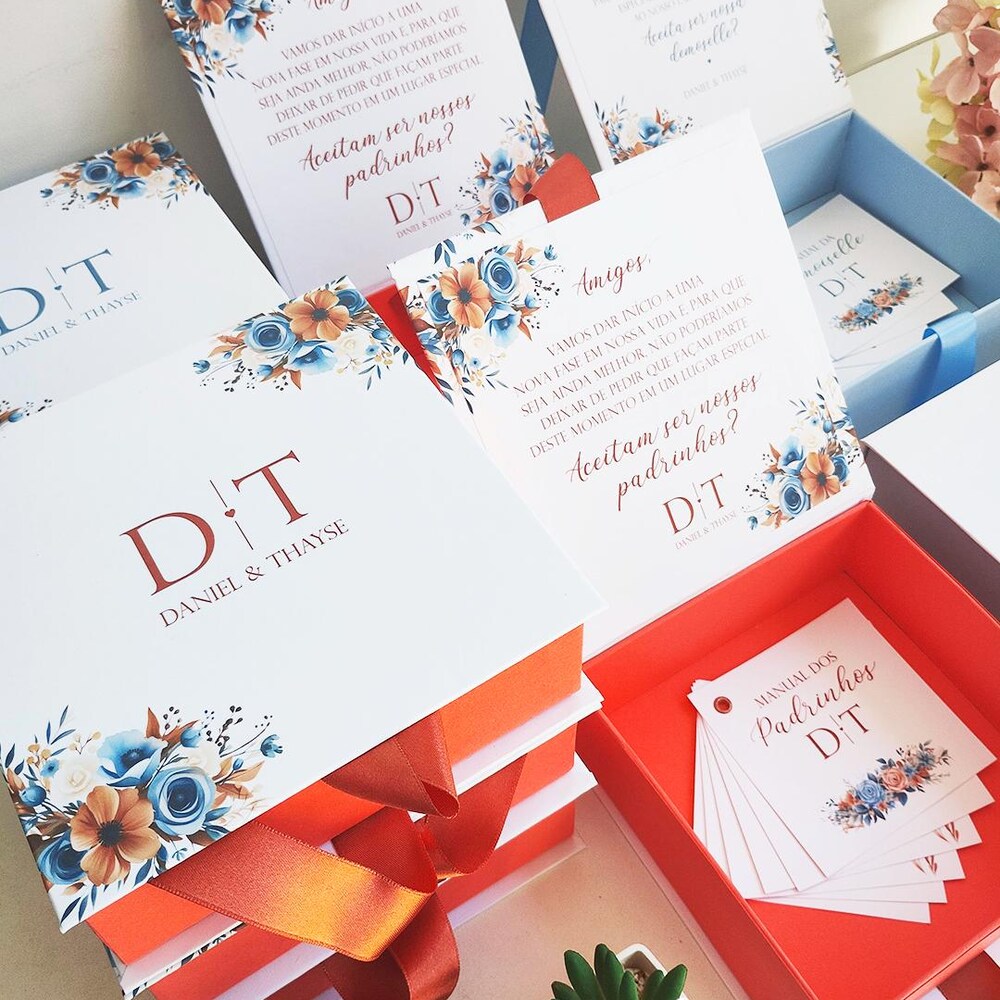
Your images should answer: what is it, what does it look like finished, and what do I receive. If you sell digital downloads, one image should clearly say “digital file – no physical item”. It sounds obvious, but it prevents refunds and unhappy messages.
If you sell on Etsy, spend time getting your mock-ups right. If you’re not sure how to use them without making your shop look inconsistent, Etsy Listing Mockups: Download & Use Them Well walks through the practical side of it.
Licensing and PLR: keep it simple, keep it clear
Licensing is where side hustles get messy fast, mostly because sellers aren’t sure what they’re allowed to do, and buyers are scared of getting it wrong.
If you create everything yourself, you still need to tell customers what they can do with it. Can they use it commercially? Can they make physical products? Can they use it in their own digital products? Can they claim it as their own design? A clear licence removes friction.
If you’re using commercial-use design assets or PLR, be extra disciplined. PLR can be a brilliant time-saver because it gives you a starting point, but it’s not magic. You still need to improve it, brand it, and package it so it’s genuinely better than what someone else could do with the same base file.
When you’re building products on top of commercial assets, your calm rule is: read the licence before you build, not after you’ve listed. If you want a plain-English explanation of what buyers typically mean by “commercial use” in the sublimation world, Commercial Use Sublimation PNG: What It Really Means is a solid reference.
Pricing: choose a number you can stand behind
Underpricing is common, especially for mums who feel guilty charging for something “that only took me an hour”. You’re not charging for the hour. You’re charging for the result, the file quality, the buyer’s time saved, and the fact they can use it instantly.
A helpful way to set pricing without spiralling is to decide what you’re optimising for:
If you want fast volume, you may price lower and rely on bundles, seasonal spikes, and repeat customers.
If you want fewer customers but higher profit per sale, you’ll price higher and focus on premium packaging: better mock-ups, cleaner sizing, more thoughtful variations, stronger themes.
It also depends on your niche. A generic printable is competing with thousands. A tightly themed wrap that fits a popular product size and matches what shoppers want right now can support a higher price.
Your 2-hour weekly system (the one that actually fits mum life)
If your time is patchy, build a rhythm that doesn’t require “big creative days”. Two focused hours a week can move the needle if you do the right things.
Hour one is creation. Not starting from scratch, but building the next file in a repeatable series. Keep the same template, font pairing, and layout rules. Save everything neatly.
Hour two is sales assets. One listing, tidy photos, clear description, licence notes, and keywords. Then a quick promotion: one Pinterest pin, one Instagram post, or an email if you have a list.
The goal is consistency, not intensity. If you do this for eight weeks, you don’t just have eight products. You have a shop that looks alive, a style that’s recognisable, and data on what people click.
This is exactly how I got started
The two-hour system I just described isn’t theoretical. It’s the exact approach I followed when I started building my digital products business.
I didn’t wake up with a perfectly structured shop or some secret strategy. I joined a membership that taught digital product sellers how to build properly from the beginning — one product type, one clear customer, one repeatable system.
That membership was Passive Income Society.
Instead of bouncing between ideas, I followed a structured method. I focused on standardised product formats. I learned how to package files correctly, price them confidently, and build collections instead of random listings.
Most importantly, I stopped guessing.
Having a roadmap meant I wasn’t wasting my limited time on products that looked good but wouldn’t sell. I knew what to create next. I understood why it would work. And I built steadily from there.
If you’re reading this thinking, “I don’t want to piece this together from 20 different free videos,” I completely get it — because that’s exactly where I was.
Passive Income Society isn’t always open publicly, but there is currently a backdoor access link available here:
👉 Access Passive Income Society here
You can absolutely try to DIY everything. Many people do. But for me, joining a structured membership shortened the learning curve dramatically and turned this from “another idea” into an actual income stream.
If you want clarity instead of chaos, that’s the difference.
The most common mistakes (and the calmer fix)
The first mistake is making too many formats at once. A printable, a PNG, a wrap, a mock-up, and a journal kit in week one sounds productive, but it scatters your learning. Pick one.
The second mistake is skipping standardisation. If your files don’t follow consistent sizing, naming, and folder structure, you’ll waste time every single week. Set your rules early and stick to them.
The third mistake is building without checking demand. You don’t need complicated research. Just notice what customers keep asking for, what themes are everywhere in gift season, and what your competitors are selling repeatedly.
The fourth mistake is relying on motivation. Motivation comes and goes. A small weekly system is what keeps the side hustle gentle enough to last.
Is a digital products side hustle for moms still worth it in 2026?
Short answer: yes — but not if you approach it randomly.
The market isn’t “too saturated.” It’s just more educated. Buyers expect better sizing, cleaner design, clearer listings, and more thoughtful collections than they did a few years ago.
That’s actually good news.
It means sellers who treat this like a structured business — not a hobby — stand out quickly.
The mums who struggle are usually creating without checking demand, mixing too many product types, or underpricing because they’re unsure of their value. The ones who grow steadily follow a system. They build repeatable formats. They refine what works instead of constantly starting over.
Digital products aren’t dead. But winging it is.
If you’re willing to approach this strategically, there is still plenty of room — especially in well-defined niches with standardised formats.
And if you’d rather learn that structure from people already doing it successfully, that’s exactly why programs like Passive Income Society exist. They shorten the trial-and-error phase and help you build properly from the start.
If you want this to feel doable, start embarrassingly small: one product type, one theme, one listing this week.
That’s how most real digital product businesses begin — not with a viral moment, but with a simple file that solves one clear problem.
You can build slowly and figure it out as you go. There’s nothing wrong with that.
But if you know you work better with structure, clarity, and a proven roadmap, that’s exactly why I joined Passive Income Society in the first place. I didn’t want to spend a year second-guessing every decision. I wanted to know what to build, how to package it properly, and how to grow it steadily around family life.
That membership gave me the framework I still use now.
If you’re ready to treat your digital products side hustle like a real income stream — not just an idea you keep putting off — you can access Passive Income Society through the backdoor link here while it’s available:
Calm progress. Clear structure. Repeatable income.
That’s the goal.
Ready to Turn This Into Your First Digital Product?
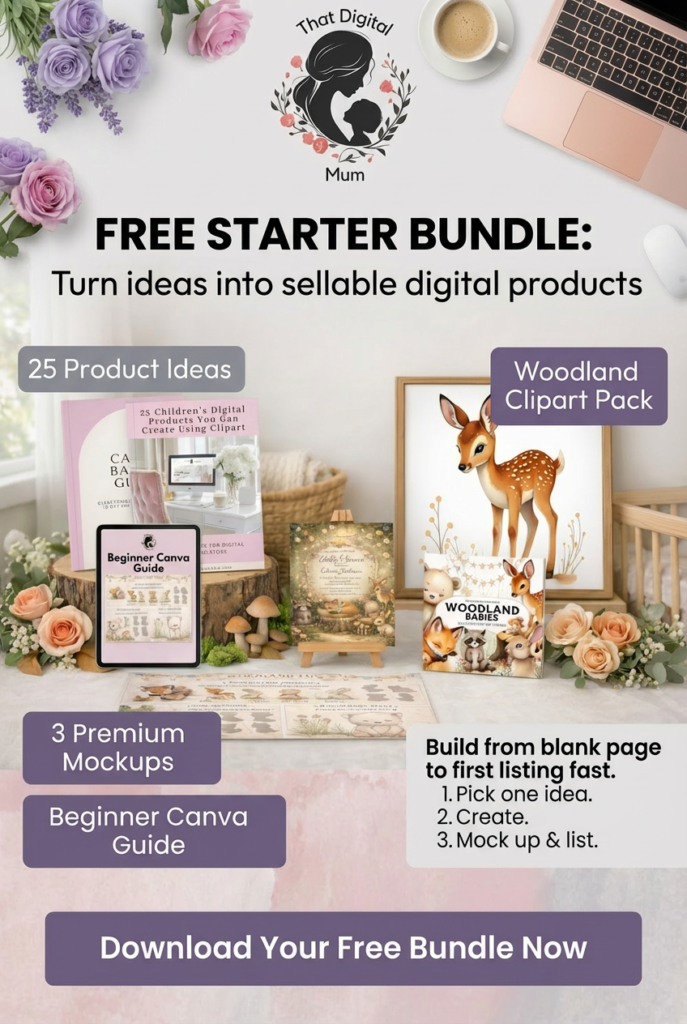
If you’re reading this thinking “this sounds great, but I don’t know what to actually create first” — I made something for you.
The That Digital Mum Free Starter Bundle walks you through the exact process I used to start selling digital products as a busy mum.
Inside you’ll get:
• 25 product ideas you can create this week
• A beginner-friendly Canva guide
• 3 premium mockups to make your listings look professional
• A woodland clipart pack to start designing immediately
No fluff. No tech overwhelm. Just a clear starting point.
Grab it here.