Sell Children’s Printables on Etsy (Without Overwhelm)
You can spend hours designing the “perfect” kids’ printable… and still get no sales if the product, listing, and file setup don’t match what Etsy shoppers are actually searching for.
If you’re a beginner trying to figure out how to sell children’s printables on Etsy, it can feel confusing fast. There’s advice about trends, keywords, bundles, mockups, pricing — and suddenly your “simple digital side hustle” feels anything but simple.
The truth is, learning how to sell children’s printables on Etsy isn’t about being the most creative designer. It’s about being clear. Clear on the age group you’re serving. Clear on the problem you’re solving. Clear on how your files are delivered and presented.
Selling children’s printables is one of the calmest digital side hustles for busy beginners because you can create once and sell repeatedly. But it only stays calm when you treat it like your first small product line — not a random collection of cute PDFs.
Below is a practical, no-faff guide to how to sell children’s printables on Etsy — from choosing what to create, to getting found in search, to delivering files that don’t create customer service headaches.
Why Most Beginners Struggle to Sell Children’s Printables on Etsy
Most beginners don’t fail because their designs are bad. They struggle because they create in isolation — without checking demand, without understanding how parents actually search, and without structuring their shop like a focused product line.
A common pattern looks like this:
You design something cute.
You upload it with a vague title.
You hope Etsy will “push” it.
You hear nothing.
When you’re new and trying to figure out how to sell children’s printables on Etsy, it’s easy to assume the problem is talent. It rarely is.
The real issue is usually clarity:
No defined age range.
No specific problem being solved.
No keyword alignment.
No consistency across listings.
Selling children’s printables successfully isn’t about uploading more. It’s about building the first 5–10 listings strategically so Etsy understands your shop and parents immediately understand who it’s for.
Once you shift from “random printable creator” to “focused solution provider,” everything gets simpler — and your shop starts to look intentional rather than experimental.
Start with children’s printable products that already sell
Children’s printables sit in a few clear buying moments: parents trying to reduce screen time, teachers and homeschoolers planning lessons, and mums sorting routines and behaviour in a way that doesn’t feel harsh.
If you’re new, don’t start by inventing a brand-new concept. Start by choosing one “lane” and building depth in it so your shop looks intentional.
The safest lanes tend to be:
- Routine and behaviour: morning routine charts, bedtime checklists, reward charts, chore charts, “kind words” posters.
- Learning packs: alphabet tracing, number recognition, phonics, sight words, times tables, handwriting lines.
- Party and seasonal: scavenger hunts, birthday games, Christmas activity packs, Easter colouring and activities.
- Quiet-time activities: colouring pages, “I spy” sheets, maze packs, dot-to-dot, cut-and-stick activities.
A quick reality check: Etsy is crowded for generic colouring pages and basic alphabet sheets. That doesn’t mean you can’t sell them – it means you need a sharper angle. Age-specific bundles, themed packs (dinosaurs, fairy tale, construction), and “done-for-you week” sets convert better than single random pages.
Pick an age range and stick to it for your first 10 listings
One common reason shops stall is they try to serve everyone from toddlers to Year 6 in the same week. Your designs, language and even fonts change depending on age.
Choose one age band to begin:
- 2-4: big shapes, thick lines, minimal text, simple routines and sticker charts.
- 5-7: early readers, phonics, reward systems with simple goals, short activities.
- 8-11: independence planners, homework trackers, more detailed puzzles and games.
When your first 10 listings all clearly serve the same type of buyer, Etsy has an easier time understanding your shop, and shoppers feel confident that you “get” their child.
Design for printing realities (so customers don’t complain)
Kids’ printables get printed at home on budget printers. If your colours are too pale, lines too thin, or margins too tight, you’ll get messages like “it printed funny” and “it doesn’t fit the page”.
Aim for boring-but-reliable:
Use A4 as your default for the UK market, but consider including US Letter as well if you want broader reach. Keep important elements inside safe margins, choose high-contrast linework, and avoid tiny text.
If your printable relies on colour (for example, a colour-coded routine chart), include a “low ink” version. Parents love anything that saves printer ink, and it’s an easy way to look more professional than the average listing.
Package your files like a pro (PDFs, sizes and instant access)
Etsy customers don’t want a file puzzle. They want to download, print, and move on with their day.
For most children’s printables, a PDF is the simplest delivery format. If you’re offering editable versions (which can sell well), be very clear about what software is required and what can be edited. If it’s not genuinely easy, don’t call it easy.
A calm, low-support approach is:
- Provide a single PDF for printing, plus separate PDFs if you’re offering multiple sizes.
- Name files clearly: “A4_RewardChart.pdf”, “USLetter_RewardChart.pdf”.
- Add a one-page “Read Me” with printing tips (paper size, scale at 100%, how to print multiple pages).
Also, check Etsy’s file limits before you build giant bundles. If your pack is large, you may need to split downloads across multiple files. That’s fine – just explain it in your listing in one simple sentence.
Create listings that match how parents actually search
Parents don’t search like designers. They search like tired humans: “morning routine chart toddler”, “kids reward chart printable”, “screen time rules poster”.
That means your listing needs to be plain and specific.
Titles: lead with the main keyword, then clarify
A strong title reads like a shopping list, not a poem. Put the core product first, then age/theme, then format.
For example: “Morning Routine Chart Printable for Toddlers, A4 + US Letter, Editable PDF” (only say editable if it truly is).
Photos: mockups matter more than you think
With digital downloads, your photos do the selling. Show the printable in a real-life context: on a fridge, in a child’s room, clipped to a homework folder. Include at least one image that makes it obvious what’s included (for example, a collage of pages for a bundle).
If you want to make your listings look polished quickly, use mockups consistently across your shop. This helps your brand feel cohesive and trustworthy. Our guide, Etsy Listing Mockups: Download & Use Them Well, walks you through using mockups without making your listings feel “stocky” or misleading.
Description: answer the three questions buyers panic about
Most customer messages come from uncertainty. Your description should calmly answer:
What is it? Who is it for? How do I print and use it?
Be clear that it’s a digital download, not a physical item. Then list what’s included, sizes, and a simple printing note (A4/US Letter, print at 100%). If you offer a bundle, state the number of pages.
Price like a small product line, not a one-off download
Pricing children’s printables is a balancing act. Too low and you attract bargain hunters who message constantly. Too high and you won’t get the early sales you need for momentum.
A simple approach is to price based on:
- Outcome (a routine chart that saves mornings is worth more than a single colouring page)
- Depth (bundles generally convert better than single sheets)
- Uniqueness (a generic “alphabet” is everywhere; a themed pack for a specific age is not)
Rather than listing 30 single pages at 99p, consider creating a smaller number of higher-value listings: bundles, sets, and “choose your theme” variations. This is calmer to manage and usually leads to better average order value.
Make your shop feel safe and professional
Parents are cautious buyers. They want to know the download will work and they won’t waste money.
A few small trust-builders go a long way:
Use consistent branding across listing images (same style, same lighting, similar layout). Write a friendly but clear shop announcement. Add a short FAQ that covers printing and downloads. And keep your “digital item” wording consistent everywhere so there’s no confusion.
If you’re offering anything that touches behaviour and emotions (reward charts, feelings charts), keep the language kind and supportive. Shoppers can feel when a product is coming from a calm place.
Understand licensing if you use commercial assets
If you’re creating your own artwork, you’re fine. If you’re using clipart, fonts, or templates from other designers, check the licence terms properly.
This is where many Etsy sellers accidentally trip up. Some assets are for personal use only. Some allow commercial use but limit end products, require attribution, or forbid resale as a digital download.
If your plan is to sell printables that include third-party graphics, you need assets that explicitly allow that usage. If you’d rather not spend evenings deciphering licensing, choosing commercially-ready design assets can make this much simpler – and it’s why shops like That Digital Mum exist for creators who want ready-to-use files and clear terms.
Get found: tags and categories that do the heavy lifting
Etsy SEO isn’t about tricking the algorithm. It’s about being painfully clear.
Use your categories properly (don’t dump everything into “printables”). Then use tags that reflect:
- the main product name (reward chart, routine chart, colouring pages)
- the age range (toddler, preschool, kindergarten)
- the use case (homeschool, classroom, screen time, bedtime)
- the format (printable PDF, A4 printable)
Avoid tags that are too vague like “kids printable” on their own. They’re competitive and don’t tell Etsy what problem you solve.
Reduce refunds by setting expectations early
Digital products can be refunded less often when your listing is crystal clear.
In your images and first lines of the description, say “digital download” and show what’s included. If it’s not editable, say so. If it requires cutting, laminating, or assembling (like flashcards), mention that too. Customers are usually happy to do a bit of prep – they just don’t like surprises.
Also, test-print your files. It sounds obvious, but many sellers never do. Print on a normal home printer, check margins, and try it at 100% scale. If you’re selling an activity pack, run through it like a parent would. You’ll catch the “this is fiddly” moments before a buyer does.
Grow with calm: bundles, seasons and repeat buyers
Once you have a handful of sales, your goal isn’t to create more and more random listings. It’s to build repeatable collections.
Think in sets: “Bedtime Routine Set”, “Morning Routine Set”, “School Morning Set”. Create seasonal refreshes: back-to-school packs, summer road trip games, Christmas quiet-time bundles. Parents love buying what they need right now, and teachers plan ahead.
A helpful rhythm is to create one core product, then spin it into variations that genuinely serve different buyers. A toddler chart needs pictures and ticks. An older child might prefer a checklist and a weekly tracker. Same concept, different execution, and you’re not reinventing the wheel every time.
Ready to Create Your First Children’s Printable?
If you’ve been reading this thinking, “This makes sense… but I still don’t know what to actually create first,” that’s completely normal.
Starting is the hardest part — especially when you’re trying to learn how to sell children’s printables on Etsy without overcomplicating it.
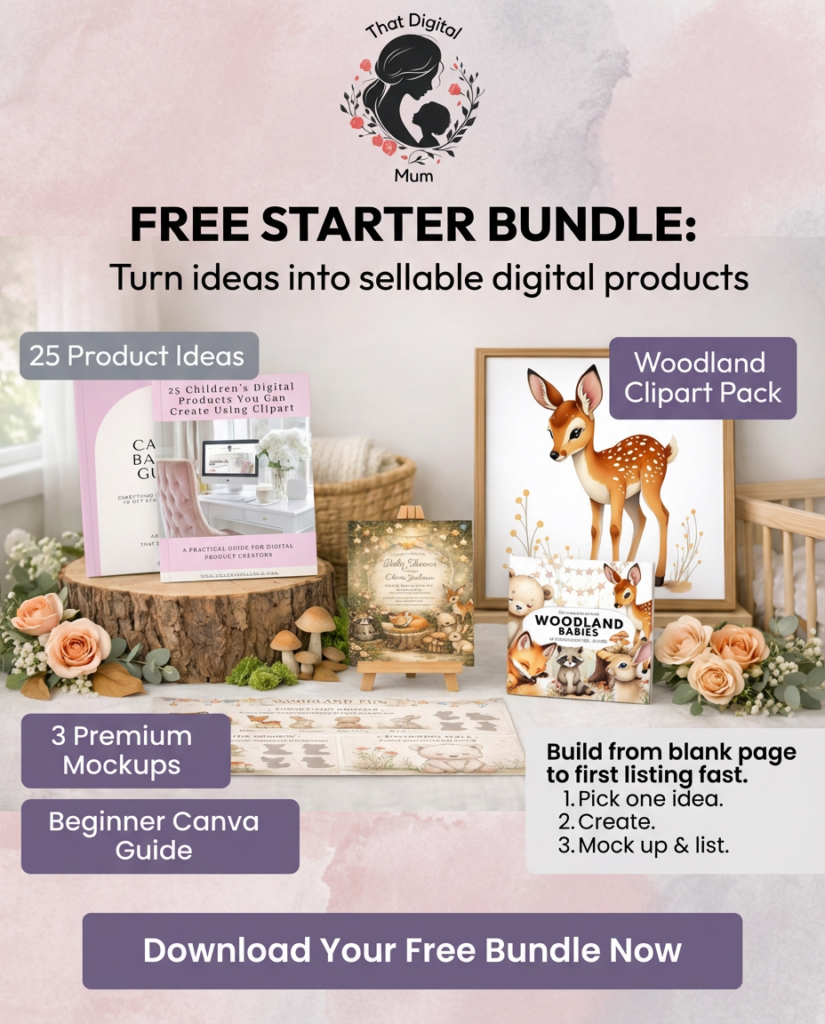
That’s exactly why I created a free starter bundle designed specifically for beginners who want to create their first children’s digital product properly from day one.
Inside, you’ll get:
A focused starting point (so you’re not guessing what to make)
Guidance on structuring your first printable
Simple direction on setup so your files are Etsy-ready
A calm, beginner-friendly approach you can actually follow
Instead of designing randomly and hoping it sells, you’ll be building your first product with clarity.
You can access the free starter bundle here and start creating your first children’s printable the structured way.
If you want a closing thought to keep you steady: treat every children’s printable like it’s going to land in a real home on a busy weekday. If it prints easily, reads clearly, and solves one specific problem, Etsy shoppers will feel that – and you’ll build sales without turning your evenings into chaos.
Ready to start your digital products journey but aren’t sure where to begin?
Unlock the secrets to success with the society that transformed my clipart store, Clip Craft Emporium! Meet Jessa Bellman, the digital products and Etsy store expert who guided me in launching a thriving business. Discover more about Jessa in this blog post.
Why wait? Dive into the Passive Income Society today! As a proud member, I continue to gain invaluable insights from Jessa and enjoy the support of a caring, like-minded Facebook community.
Opportunities like this are rare, but you can access the Passive Income Society through my exclusive link. Don’t miss out on this chance to elevate your business journey!